The Tunnel Bus Bust
January 20, 2026
On the day I set out to shoot my Chinese Tunnel video on January 13, 2026, I was confident that I was as prepared as I could be. I’d been thinking about this for a few months. In December, I had used the Naver Map equivalent of Google’s Street View to scout the route I planned to walk. I knew exactly where the pedestrian infrastructure vanished and which sections of road were too dangerous to walk. I knew the route I was following, which bus I needed, where I was going to catch it, and where I was going to step off of it.
Then reality stepped in to teach me a couple of lessons.
The first wrinkle
I arrived at Bosan Station around 8:50 in the morning and encountered my first wrinkle before I even pulled my camera out of my backpack. I opened the Naver Map app on my phone and typed the tunnel name, 창옥굴 (Changokgul), into the search bar.
Not found.
This was unexpected. Just two weeks earlier, the same search had planted a marker on the map at the tunnel’s location. I scrolled around the map and found the one-lane road where the tunnel resides, but I couldn’t set a marker on it. I asked ChatGPT for help and it very quickly found an address. I punched that into the search bar and was rewarded with a marked location that I could set as my destination.
Lessons Nos. 1 and 2
Naver Map suggested a couple of variations on the ‘best’ route. I decided to stick with the ‘best’ one since it was the most direct. If I ever walk out that way again, I’ll take one of the alternate routes.
The route took me through an industrial complex. In the video, you can hear me talking about the haze in the air and how I’m uncomfortable breathing it in. I was surprised that what I saw in person doesn’t come across on screen. It was a yellow haze that looked heavier than smoke. It gave the impression that it was hanging in the air. I could feel it in my throat and lungs.
I walked through it for probably less than a minute, but that was enough to irritate my lungs and give me a headache that lasted for almost an hour.
One of the alternate routes branched from the point in the video where I crossed the main road to go onto a country lane. It followed the main road for a bit before turning onto a smaller street that ran through a village outside of Cheongsan Station on the west side of the stream. Going that way would have allowed me to avoid the industrial complex on the east side.
From that crosswalk where the routes diverge, there’s no sidewalk on the main road. It’s not unwalkable, and I would have been fine. There are actually a couple of other alternative routes that the map didn’t highlight. They branch off that country lane. So I had options. I just didn’t know there would be anything wrong with the main route.
And that was my problem. It wasn’t the fact that the map led me through that industrial complex, it was that I didn’t pay any attention to what was on the map. I was just blindly following the route. That said, I probably wouldn’t have thought twice about walking through that industrial complex had I noticed it on the map. I wouldn’t have expected pollution like that to be down at street level.
The lessons I’m taking from this: always pay attention to what is on the map around the suggested routes, and avoid industrial complexes where possible.
When I started back home that day, I ended up walking to Cheongsan Station from the north side, following that alternative route in reverse. I enjoyed walking through Choseong 2-ri, the little village there. It was a more pleasant atmosphere than the ugly road that led to the industrial complex.
Lesson No. 3
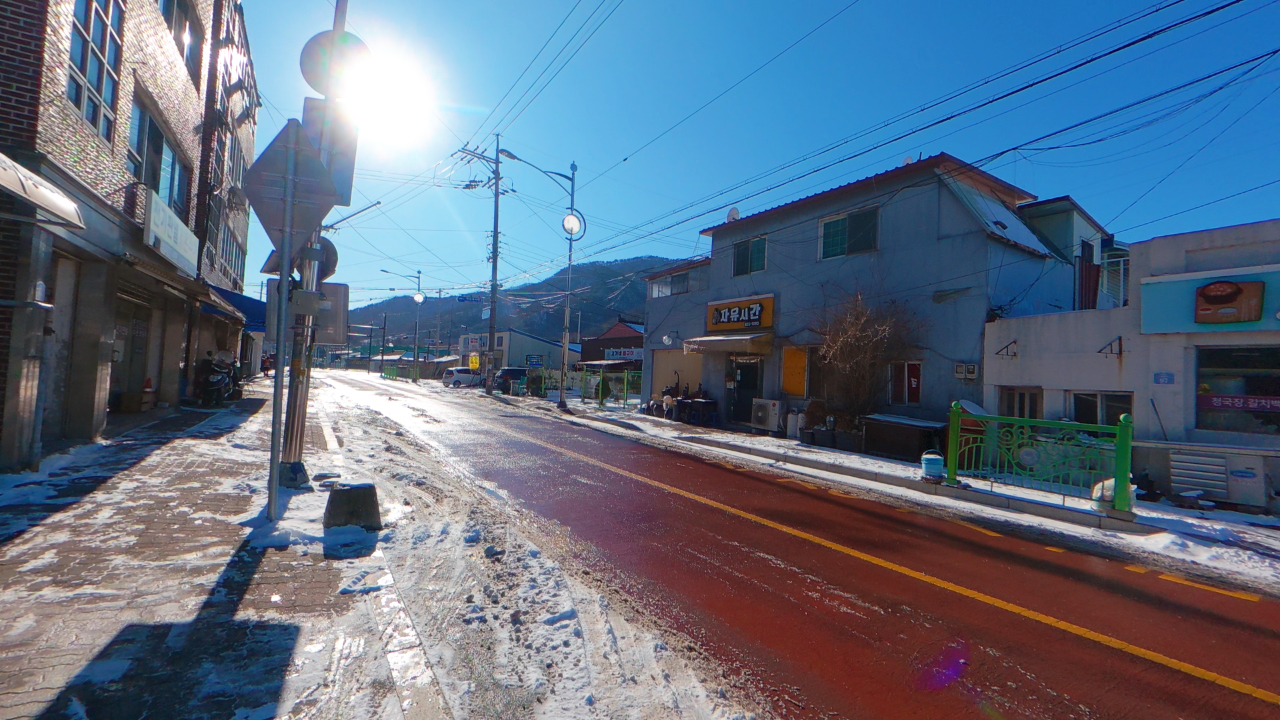
Once I got going on the main road, I saw a CU up ahead. I had to take a wee, so I made a pit stop and then figured this was a good time to grab a bite. It was around 12:50 when I sat down to eat a sandwhich. I was out of there just a little past 1:00 and found myself at my target bus stop just before 1:15.
I had highlighted the stop on Naver Map a few weeks before and knew that the 91 bus stopped there. I had scouted the route and knew that it would drop me off just below the tunnel. What I hadn’t done was dig into the bus schedule. I knew the first bus on the route was at 10:00 a.m. and the last one at 5:30 p.m. I assumed that was all I needed to know.
This is where the third lesson comes in, a very annoying lesson about rural bus routes.
There was no passenger information system display at the stop, so I pulled up KakaoBus on my phone and was immediately confused. The app was telling me that there was no ETA, and the real-time display showed only one bus on the route. Surely there must be at least two. It’s not a short route. If there’s only one, that’s a long wait at any given stop.
The active bus passed the bus stop across the street, heading back to Soyosan Station, at exactly 1:22. The bus driver looked at me as he passed.
This didn’t bother me. I couldn’t find a schedule anywhere, but surely the second bus that I was sure existed would leave out from there at 1:30. A sort of tag-team situation. I’d be at the road to the tunnel before 2:00. All good.
At 1:35, the real-time display on KakaoBus showed no new bus active on the route. Ditto at 1:45. There really was only one bus, and there were apparently large gaps between departure times from Soyosan Station. It was pretty clear at this point that the lone bus wouldn’t start again until 2:00.
It was then I realized that I had only 20% battery remaining on my phone. I’d been using it almost non-stop at the CU and the bus stop, and it seems all that route monitoring drained it pretty quickly. I’d had over 30% at the CU.
Dilemma time. Even if I’d had more battery, walking was out of the question. Parts of the road had no more than a narrow gully next to a wall or safety barrier in which I could walk. And forget about the bridges. No space at all. Dangerous at any time, but even moreso in the frozen conditions that day.
I had expected to be at the road to the tunnel before 2:00 and be on the bus out of there by 3:30. Now I saw it would be at least 2:30 before I arrived and who knew how long before I’d be able to catch that solitary bus. This was a problem because I’d told my wife I’d be home by 5:00. My mother-in-law attends a senior daycare center on weekends, and someone has to be at home when they drop her off in the evening before 5:30. My wife was usually was able to, but that day she was out of the house for work.
I could have called my brother-in-law and asked him to handle it for me, but the low battery decided me. I didn’t want to risk being out there with no battery, unable to communicate with my wife. The really annoying thing is that I’d considered bringing a battery pack with me in case I needed to charge my phone. I’ve had some long days without needing a charge, so ulitmately decided it wasn’t important. I hadn’t accounted for how much pressure I’d be putting on it.
It was all good, though. I turned around and walked to Cheongsan Sation, luckily just in time to catch a train. They only run once an hour north of Dongducheon Station. I got home 15 minutes before my mother-in-law arrived.
I was up early the next morning and stepped off the metro at Dongducheon Station around 9:00. I decided to walk to Soyosan Station, and got there well before the 10:00 a.m. bus.
The driver was a pleasant dude. In chatting with him, I found that he knew of the tunnel, though he knew it by a different name. He took me past my bus stop and dropped me off at the road leading to the tunnel.
The lesson I learned here: always, always investigate the bus and train schedules in rural areas. I was well aware they don’t run as often as they do in the cities, but I had never encountered one like this. Or, I should say, I’d been fortunate enough when catching rural buses to get them at the right time.
What a walk
Despite the hiccup, I had fantastic walks on both days. Walking through that fresh snow on the first day in the crisp, cool country air was a wonderful experience. Following the old single-lane road to the tunnel was amazing, especially along the bits where I could look out over the stream below.
One thing I didn’t show in the video: there’s an old sign near the entrance to the tunnel road. It’s facing traffic coming down the hill from the tunnel, so I didn’t notice it until I was walking back.
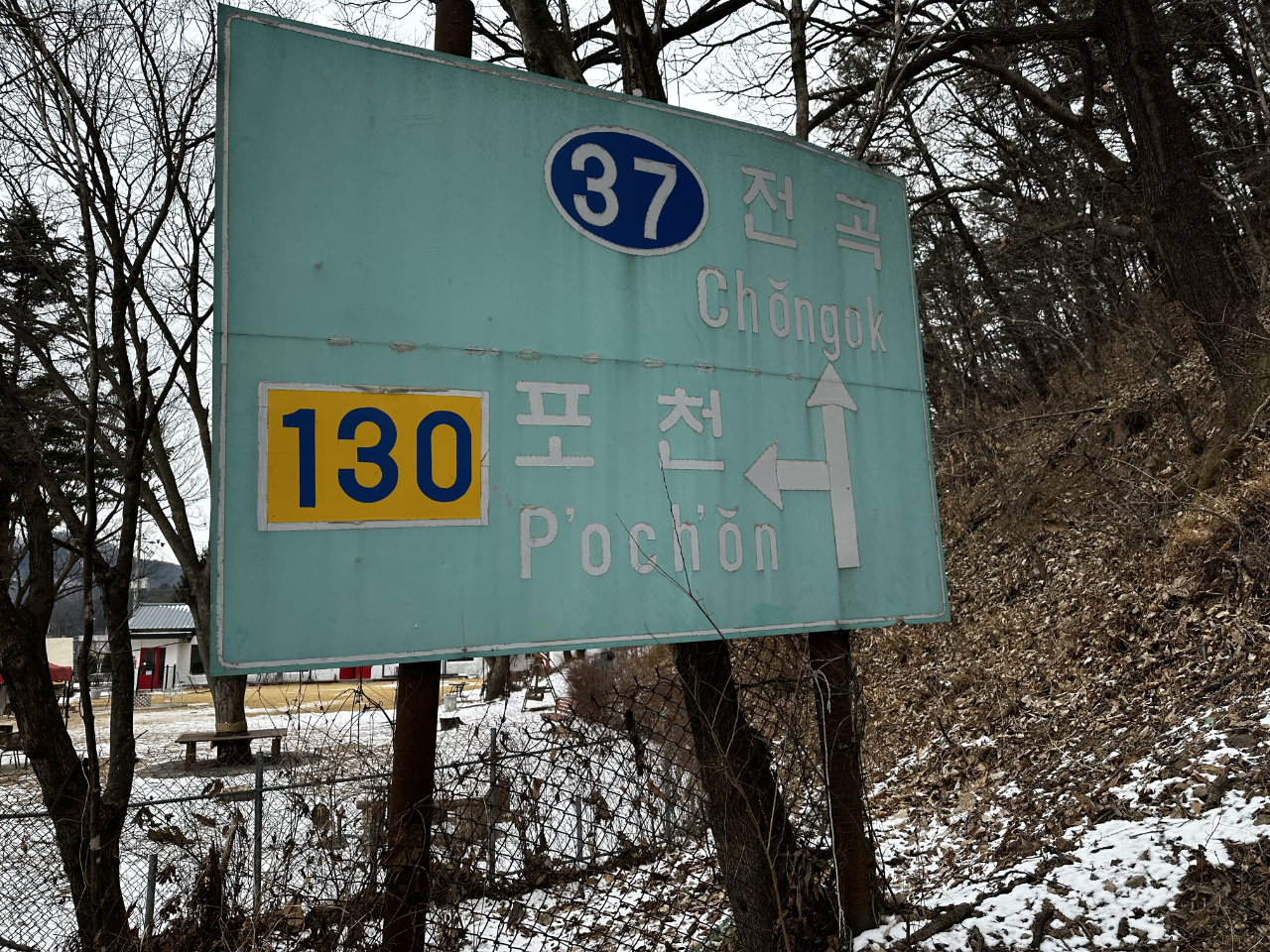
See how 포천 is Romanized as P’och’ŏn? That’s the old McCune–Reischauer Romanization form, a clear indicator that this sign was put up at some point before July of 2000. That’s when the government officially adopted the Revised Romanization syntax, in which 포천 becomes Pocheon. I wouldn’t be surprised if this sign was there in the autumn of 1991 when I first drove by in a tracked ambulance as part of a tank battalion convoy.